 English
 Dansk
 Deutsch
 Español
 Norsk bokmål
 Svenska
A project can show a healthy profit and still drain your cash. In project businesses, money comes in lumps (on-account invoices by progress, milestones and the final account), while payments out follow purchasing and payroll. A cash flow budget built for steady monthly income will not pick this up.
Profit and cash are two different questions
The profit and loss budget asks whether revenue covers costs in the period. The cash flow budget asks whether there is money in the bank on the day the bills fall due. The gap comes down to three things: accruals (a cost can be incurred long before it is paid, and vice versa), payment terms (the customer may pay 30 days after the invoice, while wages go out on the 20th) and items that are not profit or loss at all: VAT, contract security, loan repayments and capital spending.
| At 31 October | Amount | What the figure answers |
|---|---|---|
| Profit to date (revenue by progress) | 215 636 | Has the project made money so far? |
| Invoiced to the customer to date | 3 120 000 | What have we asked the customer to pay? |
| Costs incurred to date | 3 242 200 | What has the project cost so far? |
| Cumulative cash flow | −634 200 | How much cash has the project tied up? |
All four figures are right at the same time. Profit is positive and invoicing sits close to costs, but cash is negative because customers pay after suppliers and wages have gone out.
Why project businesses need their own setup
Most free templates have one row for “sales” and one for “purchases”. That is too coarse for an installer. Three features set project work apart:
- Large purchases early on. Air handling units, switchboards and special components are ordered and paid for long before they can be invoiced as completed work.
- Invoicing by progress. In building and construction, sales documents can be issued as the work progresses (§ 8-1-2a of bokføringsforskriften, the Norwegian Bookkeeping Regulations). Every month you do not invoice completed work is a month of credit to the customer.
- The final account comes late. Under the Norwegian standard contracts NS 8405 and NS 8407, the final account must be submitted within two months of handover, and the client then has two months to pay and raise objections. The last part of the contract sum can therefore arrive a quarter or more after the job is finished.
Worked example: one contract month by month
Take a ventilation contract worth NOK 4,800,000 plus an approved change of NOK 78,000, running from March to January with handover in January. We have entered costs incurred per month, on-account invoicing by progress and these assumptions: wages are paid in the same month, suppliers are paid after 30 days, on-account invoices are paid the month after invoicing, and the final invoice from January is paid in March.
Limits of the example: The figures exclude VAT so that they can be compared with the budget and the result. In reality the customer pays you, and you pay suppliers, amounts including VAT, and the tax is settled per VAT period (see the section on VAT below). The example shows one project, with no overheads, guarantee fees, interest or late payment. It is meant to show the pattern, not to serve as a model answer.
| Month | Cash in | Cash out | Net | Cumulative |
|---|---|---|---|---|
| Mar 26 | 0 | 30 000 | −30 000 | −30 000 |
| Apr | 0 | 170 000 | −170 000 | −200 000 |
| May | 200 000 | 300 000 | −100 000 | −300 000 |
| Jun | 400 000 | 470 000 | −70 000 | −370 000 |
| Jul | 520 000 | 1 140 000 | −620 000 | −990 000 |
| Aug | 150 000 | 290 000 | −140 000 | −1 130 000 |
| Sep | 520 000 | 350 000 | +170 000 | −960 000 |
| Oct | 650 000 | 324 200 | +325 800 | −634 200 |
| Nov | 680 000 | 368 000 | +312 000 | −322 200 |
| Dec | 600 000 | 510 000 | +90 000 | −232 200 |
| Jan | 600 000 | 423 600 | +176 400 | −55 800 |
| Feb | 0 | 198 000 | −198 000 | −253 800 |
| Mar 27 | 558 000 | 0 | +558 000 | +304 200 |
Three things stand out. The air handling units are delivered in June and the supplier invoice is paid in July, before the customer has paid for the installation. July is fellesferie, the Norwegian common summer holiday: little progress and little invoicing, but June’s suppliers still have to be paid. And because the final invoice is paid two months after handover, the project stays in the red until March the following year, even though the forecast profit is NOK 304,200.
One project in the red is manageable. Five in the same phase at the same time are not. That is why the cash flow budget should be built per project and added up, not drawn up from the top down.
Five items general templates forget
1. VAT
Output VAT belongs to the period in which the invoice is issued, not the one in which the customer pays. VAT periods are two months long, with deadlines on 10 April, 10 June, 31 August, 10 October, 10 December and 10 February. If you invoice NOK 680,000 excl. VAT in October, NOK 170,000 in output VAT must be paid by 10 December, even if the customer pays late. Input VAT on purchases goes the other way. Put VAT in the cash flow budget as a separate line, not as part of the invoice amount.
2. Contract security
Under NS 8405 and NS 8407, the contractor provides security for 10% of the contract sum until handover and 3% for three years after that. It is usually a bank guarantee rather than cash, but the guarantee carries a commission and ties up part of your credit line at the bank. On subcontracts this often follows NS 8415 and the terms of the contract with the main contractor.
3. Late invoicing
The largest single item in many project businesses’ cash flow is work that has been done but not invoiced, because a site inspection has not been signed off, because a change has not been priced, or because nobody has had the time. Track “past planned invoice date” as a key figure of its own per project.
4. Changes not yet agreed
In the example, a change of NOK 120,000 has been notified but not agreed. It has no place in the cash flow budget until it is approved, but the cost of the work is already leaving your bank account.
5. Currency
Purchases in euros or Swedish kronor carry uncertainty over both the payment date and the exchange rate. Use today’s rate in the forecast and show open currency amounts separately.
How to set up the cash flow budget
A usable project-based cash flow budget has one tab per project and one summary tab. For each project you need these rows, with months as columns:
| Row | Source |
|---|---|
| Cash in: on account / milestone | Invoicing plan + customer’s payment terms |
| Cash in: final account | Handover + 2 + 2 months under the NS standards, or as per the contract |
| Cash out: suppliers | Purchase orders: expected delivery date + supplier’s payment terms |
| Cash out: subcontractors | Payment schedule in the contract |
| Wages and on-costs | Labour plan × hourly cost, pay date |
| VAT | Output minus input per VAT period |
| Cumulative | Sum of everything above |
The most important column holds an assumption rather than a figure: where does each amount come from? When a purchase order slips or a milestone moves, it should be obvious which row changes. Otherwise you end up with a spreadsheet nobody trusts after three weeks.
Keep the project tabs excluding VAT so they can be reconciled with the project budget, and put VAT in the summary tab as a separate row per VAT period. The spreadsheet then follows the same logic as the worked example.
When the spreadsheet is not enough
The spreadsheet works as long as one person owns it and there are few projects. It stops working when invoicing plans, purchase orders and labour plans change every week in other systems. Someone then has to enter the same changes in two places, and after a few weeks nobody trusts the figures.
Cash flow based on expected receipts and payments
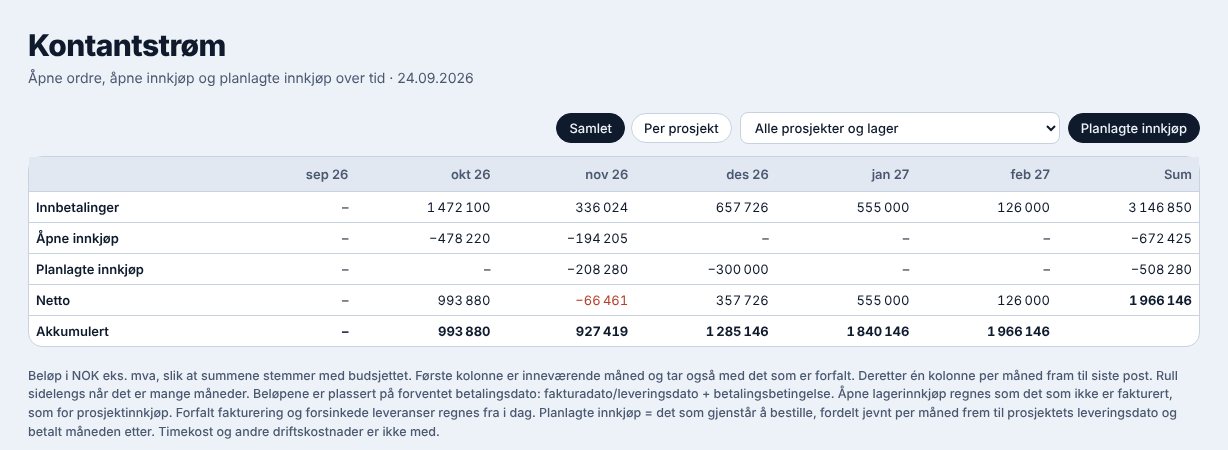
In ProfitTracker, the cash flow is built on data the project manager already works with. Cash in comes from milestones and item lines on the sales orders: invoice date plus the customer’s payment terms. Cash out comes from open purchase orders (delivery date plus the supplier’s payment terms) and any planned purchases, spread evenly up to the project’s delivery date. Move a milestone or a delivery and the forecast moves with it the next time you open it.
You should know what it leaves out: wages, hourly labour costs, VAT and other operating costs are not included, and the amounts exclude VAT. So it does not replace your company’s overall cash flow budget. What it gives you is the project part, the one that changes every week, without entering it again.
See the cash flow for your own projects, built from invoicing plans and purchase orders.